
Senyar Swamps Sumatra: A Rare Tropical Cyclone in the Strait of Malacca
Tropical cyclones almost never form over the Strait of Malacca, the narrow waterway that separates Peninsular Malaysia from the Indonesian island of Sumatra. This region lies so close to the equator that the Coriolis effect is usually too weak to allow storms to rotate sufficiently to develop into cyclones. However, on November 25, 2025, meteorologists observed a rare event: a tropical depression intensified into Cyclone Senyar, marking only the second documented tropical cyclone to form in the strait.
Senyar was confined by land on both sides, and later that day, it made landfall on Sumatra. The storm then made a U-turn, heading east toward Malaysia. As the slow-moving cyclone crossed Sumatra’s mountainous terrain, it unleashed heavy rainfall, with satellite-based estimates from NASA’s Global Precipitation Measurement (GPM) mission indicating nearly 400 millimeters (16 inches) of rain in many areas. It is important to note that local rainfall amounts may vary when measured on the ground due to the averaging nature of satellite data.
Impact of Senyar Swamps Sumatra: Flooding, Landslides, and Devastation
The intense rainfall from Cyclone Senyar caused widespread flash floods and landslides across Sumatra’s rugged landscape. Streams and rivers quickly overflowed, carrying sediment-laden and debris-filled waters that swept through villages, towns, and cities. News reports indicate that the destruction was further exacerbated by an earthquake that struck on November 27, as well as the presence of loose piles of timber in the region. These timber piles acted like destructive battering rams when swept up by the floodwaters.
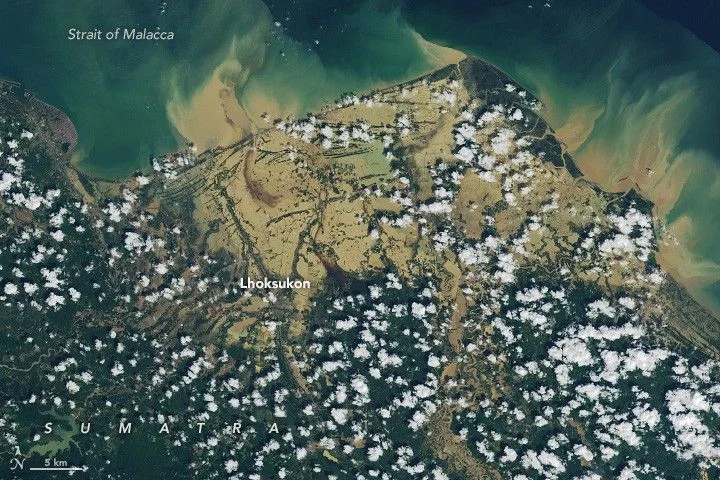
As of December 4, 2025, Indonesian authorities reported several hundred deaths and more than 700,000 people displaced by the flooding and landslides. The Operational Land Imager-2 (OLI-2) on Landsat 9 captured images on November 30 showing extensive flooding in the Aceh and North Sumatra provinces. Muddy, sediment-filled water inundated much of Lhoksukon, a town of 40,000 residents, along with several surrounding villages.
Regional Effects and Broader Implications of Senyar Swamps Sumatra
At the same time that Cyclone Senyar was causing havoc in Sumatra, other tropical cyclones and monsoon rains were impacting Sri Lanka, Thailand, Malaysia, and Vietnam. These weather events led to widespread destruction across the broader region. According to an estimate from the United Nations Office for the Coordination of Humanitarian Affairs, flooding affected more than 10.8 million people and displaced over 1.2 million individuals in the region.
The rarity of Cyclone Senyar forming in the Strait of Malacca highlights an unusual weather anomaly. The storm’s formation and devastating impact on Sumatra underscore the vulnerability of the region to extreme weather events, even in areas where such cyclones are typically rare. The flooding and landslides caused by Senyar have had a profound effect on communities, infrastructure, and the environment in Sumatra, with recovery efforts ongoing.
In summary, the senyar swamps Sumatra event was a significant and rare meteorological occurrence. The cyclone’s formation in the Strait of Malacca, its heavy rainfall, and the resulting floods and landslides have left a lasting mark on the region. The disaster has displaced hundreds of thousands and caused extensive damage, illustrating the severe consequences of tropical cyclones, even in areas where they seldom develop.
For more stories on this topic, visit our category page.
Source: original article.