
Samsung’s a Kid in Apple’s Tablet Market: Struggling to Gain Ground
Despite restructuring its premium tablet lineup last year, Samsung has not experienced significant shipment growth in the third quarter of 2025. The Korean technology giant was unable to make a meaningful impact on Apple’s dominance in the tablet market during this period. Samsung’s shipments remained stagnant, showing little to no improvement compared to previous quarters.
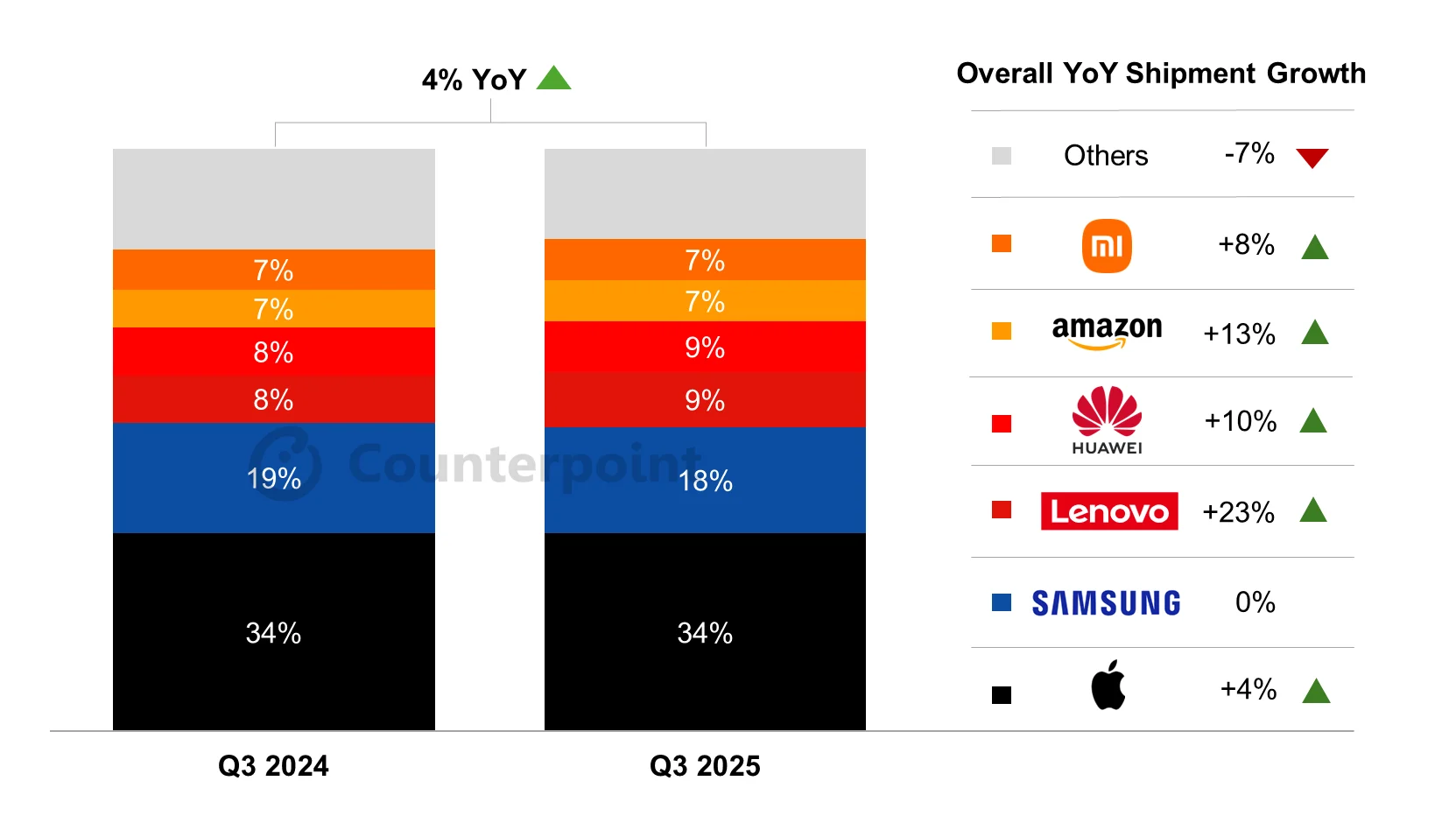
Samsung continues to hold the second position in global tablet shipments. However, its year-on-year growth is disappointing. While Samsung’s shipments stayed flat, five of its competitors managed to increase their shipments. This contrast highlights Samsung’s struggle to expand its presence in the tablet market.
Apple, on the other hand, maintained a strong lead. The company accounted for 34% of the global tablet shipment market share in Q3 2025. Apple also increased its shipments by 4% year-on-year, reinforcing its dominant position. In comparison, Samsung’s shipment share declined by 1% over the same period, and its overall shipment growth remained stagnant, according to data from Counterpoint Research.
Other competitors such as Lenovo, Huawei, Amazon, and Xiaomi managed to maintain relatively stable market shares. More importantly, these companies were able to increase their shipment volumes in the third quarter of 2025. This growth came at the expense of other brands, whose shipments dropped by 7%. Samsung, however, did not benefit from this shifting market dynamic.
Will the Galaxy Z TriFold Help Samsung’s Tablet Market Position?
Samsung hopes that the Galaxy Z TriFold might provide a boost in the tablet market. This device is a unique hybrid that combines the features of a Galaxy phone and a tablet into one. When unfolded, the TriFold offers an experience similar to that of a premium Galaxy tablet. It even runs DeX on-device, making it the first phone to do so.
However, the question remains: is the Galaxy Z TriFold truly a phone, or is it a hybrid device? This distinction matters because it is unclear whether future sales and shipments of the TriFold will be counted as tablet sales. The classification could affect Samsung’s reported tablet shipment numbers.
Additionally, the Galaxy Z TriFold will be released in only a limited number of markets. This limited availability means it is unlikely to significantly increase Samsung’s market share in the near term. Despite this, the future could look very different if the TriFold or its successor becomes available globally. Such a development might be the breakthrough Samsung needs to challenge Apple more closely in the tablet market.
Samsung’s a Kid in Apple’s Tablet Market: Current Challenges and Future Prospects
Samsung’s position in the tablet market remains challenging. Despite holding second place in global shipments, the company’s growth has stalled. While rivals have managed to increase their shipments, Samsung’s numbers have stayed flat or declined slightly. Apple continues to dominate with a growing market share and shipment volume.
The introduction of innovative devices like the Galaxy Z TriFold shows Samsung’s effort to innovate and capture more of the tablet market. However, the limited release of this hybrid device means it will not immediately change Samsung’s standing. The company’s ability to compete more effectively with Apple may depend on the global availability and success of such new products.
In summary, Samsung’s a kid in Apple’s tablet market. The Korean tech giant is still trying to find ways to grow its tablet shipments and challenge Apple’s dominance. Until then, Samsung’s tablet market share and shipment growth are likely to remain under pressure. The coming months and years will reveal whether new devices like the Galaxy Z TriFold can help Samsung close the gap with Apple.
For more stories on this topic, visit our category page.
Source: original article.