
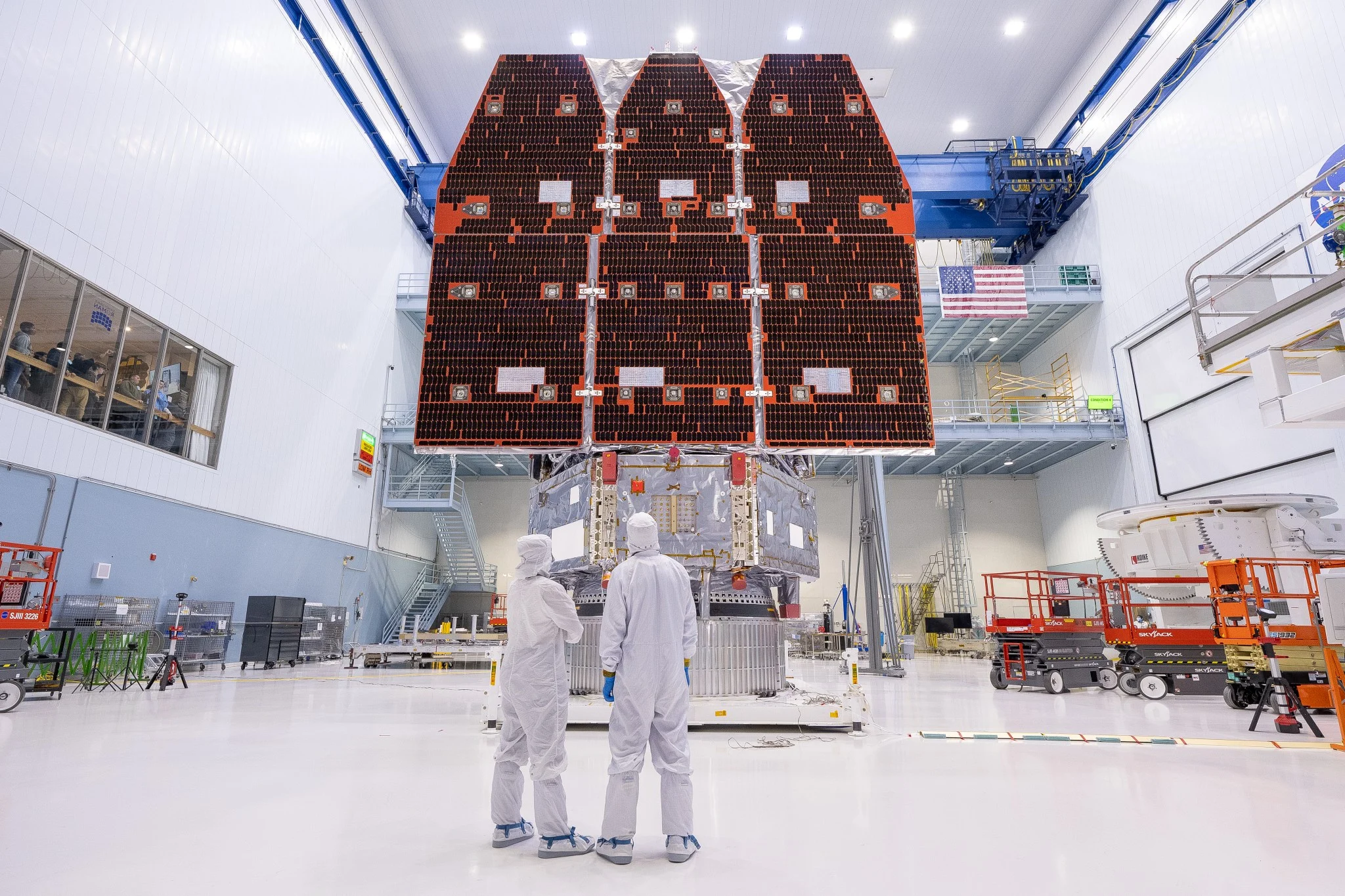
NASA Completes Nancy Grace Roman Space Telescope Assembly
NASA has fully assembled its next major space observatory, the Nancy Grace Roman Space Telescope. On November 25, technicians at NASA’s Goddard Space Flight Center in Greenbelt, Maryland, successfully joined the inner and outer segments of the telescope in the agency’s largest clean room. This milestone marks a significant step forward in the mission’s development.
The Nancy Grace Roman Space Telescope is now complete and ready to enter its final testing phase. The mission is scheduled to launch by May 2027, although the team is working toward a possible earlier launch as soon as fall 2026. Once testing concludes, the telescope will be transported to NASA’s Kennedy Space Center in Florida for launch preparations. A SpaceX Falcon Heavy rocket will carry the observatory to its operational orbit approximately one million miles from Earth.
NASA Completes Nancy Grace Roman Space Telescope: Preparing for Launch and Science
NASA Associate Administrator Amit Kshatriya described the completion of the Roman observatory as a defining moment for the agency. He emphasized that the mission’s transformative science depends on meticulous engineering, and the team has delivered an observatory that will greatly expand our understanding of the universe. As the telescope moves into its final testing phase, the focus remains on precision and readiness for a successful launch on behalf of the global scientific community.
Julie McEnery, the senior project scientist for Roman at NASA Goddard, expressed excitement about the discoveries the mission will enable. During its first five years, the telescope is expected to reveal more than 100,000 distant worlds, hundreds of millions of stars, and billions of galaxies. The data collected will rapidly increase our knowledge of the cosmos.
The Roman Space Telescope will conduct a five-year primary mission surveying vast areas of the sky. Its observations will include stars, galaxies, black holes, and exoplanets—planets orbiting stars beyond our solar system. The telescope’s location in space allows it to be highly sensitive to infrared light, which has longer wavelengths than visible light. This capability, combined with its wide field of view, will enable astronomers to explore a broad range of cosmic phenomena, from dark matter and dark energy to distant worlds and isolated black holes. The mission will accomplish in a few years what would take hundreds of years using other telescopes.
Nicky Fox, associate administrator of NASA’s Science Mission Directorate, highlighted the mission’s potential to address one of the great mysteries of the cosmos: the accelerating expansion of the universe. Roman was designed to uncover the fundamental nature of space and time behind this phenomenon. With the observatory now fully assembled and on track for launch, NASA is closer than ever to gaining unprecedented insights into the universe.
Instruments and Scientific Surveys of the Nancy Grace Roman Space Telescope
The Roman Space Telescope carries two main instruments: the Wide Field Instrument and the Coronagraph Instrument technology demonstration. The coronagraph will test new technologies to directly image planets around other stars by blocking the bright glare of those stars. This will allow scientists to observe the faint light from planets orbiting them. The coronagraph aims to capture images of giant worlds and dusty disks around nearby stars in visible light, focusing on planets that are older, colder, and closer to their stars than those previously imaged.
Feng Zhao, manager of the Roman Coronagraph Instrument at NASA’s Jet Propulsion Laboratory, noted that the coronagraph brings humanity closer to answering the profound question, “Are we alone?” The team plans to conduct a series of observations during the first year and a half of the mission, with the possibility of additional observations based on input from the scientific community.
The Wide Field Instrument is a 288-megapixel camera that will capture images spanning from our solar system to near the edge of the observable universe. Each image will cover an area of the sky larger than the apparent size of a full moon. The telescope will collect data hundreds of times faster than the Hubble Space Telescope, generating up to 20,000 terabytes (20 petabytes) of data during its primary mission.
Dominic Benford, Roman’s program scientist at NASA Headquarters, emphasized the enormous volume of data the mission will produce, which will be crucial for a wide range of scientific investigations.
Roman will conduct three primary surveys using the Wide Field Instrument, accounting for 75% of the mission’s observing time. The High-Latitude Wide-Area Survey will combine imaging and spectroscopy to study over a billion galaxies across space and time. This survey will help astronomers trace the evolution of the universe, investigate dark matter, and understand galaxy formation.
The High-Latitude Time-Domain Survey will repeatedly observe the same region of space to create time-lapse movies. This will allow scientists to study how celestial objects and phenomena change over days to years. The survey aims to probe dark energy and may uncover entirely new cosmic phenomena.
Roman’s Galactic Bulge Time-Domain Survey will focus on the center of the Milky Way, providing one of the deepest views ever of this region. Astronomers will monitor hundreds of millions of stars for microlensing events, where the gravity of an intervening object temporarily magnifies the light of a background star. This technique can detect planets in the habitable zone and beyond, including rogue planets that drift through space without a host star, as well as isolated black holes. The survey is also expected to discover about 100,000 planets that transit their stars.
The remaining 25% of the mission will be devoted to other observations selected with input from the scientific community. The first such program, the Galactic Plane Survey, has already been chosen.
To maximize scientific return, NASA will make all Roman data publicly available immediately, with no exclusive use period. This open data policy will allow multiple scientists and teams to analyze the data simultaneously, enabling a broad range of discoveries.
Honoring Dr. Nancy Grace Roman’s Legacy
The telescope is named after Dr. Nancy Grace Roman, NASA’s first chief astronomer, who championed making space-based astronomical observations accessible to all. Jackie Townsend, Roman’s deputy project manager at NASA Goddard, said the mission will produce vast amounts of astronomical imagery that will fuel groundbreaking discoveries for decades, honoring Dr. Roman’s legacy of promoting scientific tools for the wider community. Townsend believes Dr. Roman would be proud of the telescope bearing her name and excited about the mysteries it will reveal.
The Nancy Grace Roman Space Telescope is managed by NASA’s Goddard Space Flight Center in Maryland. It involves participation from NASA’s Jet Propulsion Laboratory in California; Caltech/IPAC in Pasadena; the Space Telescope Science Institute in Baltimore; and a science team from various research institutions. The primary industrial partners include BAE Systems Inc. in Colorado, L3Harris Technologies in New York, and Teledyne Scientific & Imaging in California.
With its deep, sharp infrared views and wide field of vision, the Nancy Grace Roman Space Telescope is poised to revolutionize astronomy. It will transform our understanding of dark energy, dark matter, and the prevalence of Earth-like planets in our galaxy. The mission remains on track for launch by May 2027, with teams aiming for an earlier launch in fall 2026.
For more stories on this topic, visit our category page.
Source: original article.