
Sugars, Gum, and Stardust Found in NASA’s Asteroid Bennu Samples
NASA’s asteroid Bennu continues to reveal vital clues about the early solar system and the origins of life. Scientists studying pristine samples returned by NASA’s OSIRIS-REx spacecraft have made remarkable discoveries. Three new research papers published in Nature Geosciences and Nature Astronomy report the presence of sugars essential for biology, a gum-like substance never before seen in space rocks, and an unexpectedly high amount of dust from supernova explosions. These findings deepen our understanding of the building blocks of life and the early solar system’s composition.
Essential Sugars Discovered in Bennu Samples
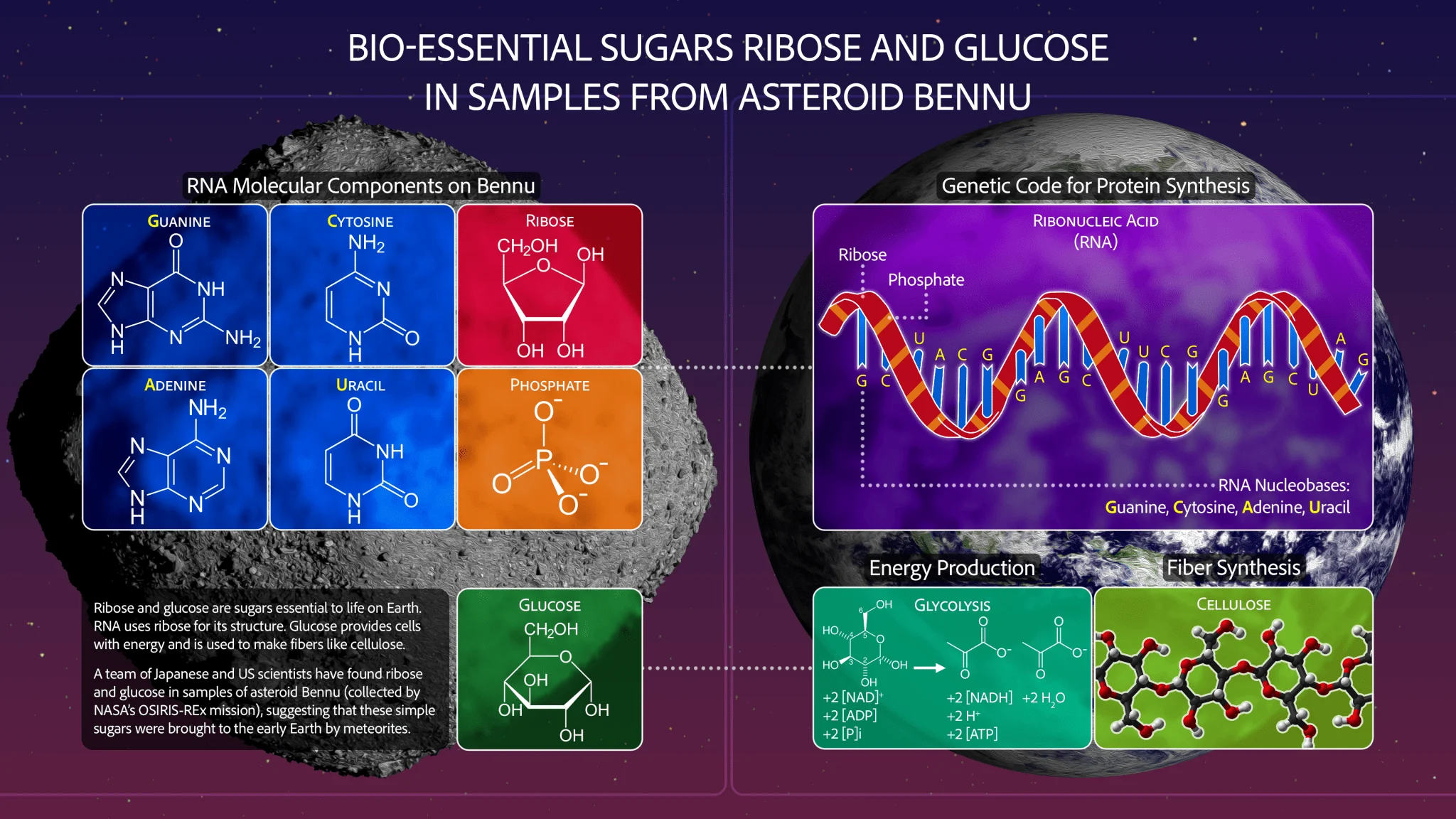
A team led by Yoshihiro Furukawa from Tohoku University in Japan identified biologically important sugars in the Bennu samples. Their work, published in Nature Geoscience, revealed the five-carbon sugar ribose and, for the first time in an extraterrestrial sample, the six-carbon sugar glucose. While these sugars do not prove the existence of life on Bennu, their presence, along with previously found amino acids, nucleobases, and carboxylic acids, indicates that the molecular ingredients for life were widespread in the early solar system.
Ribose and deoxyribose are crucial for life on Earth, forming the sugar backbones of RNA and DNA, respectively. RNA plays many vital roles in cells and is essential for life as we know it. Furukawa explained that all five nucleobases used in DNA and RNA, along with phosphates, were already found in the Bennu samples. The discovery of ribose means that all components needed to form RNA are present in Bennu.
Interestingly, while ribose was found, deoxyribose was not detected. This suggests that ribose may have been more common than deoxyribose in the early solar system. This finding supports the “RNA world” hypothesis, which proposes that early life relied on RNA as the primary molecule for storing genetic information and catalyzing chemical reactions.
The presence of glucose in the samples is also significant. Glucose is a common energy source for life on Earth, and its discovery in Bennu samples shows that important energy molecules existed in the early solar system. This discovery builds upon earlier findings of nucleobases, phosphate, and amino acids in the asteroid’s material, suggesting that meteorites like Bennu could have delivered key molecular ingredients for life to early Earth.
Mysterious Ancient ‘Gum’ and Abundant Supernova Dust
Another groundbreaking discovery comes from a study led by Scott Sandford of NASA’s Ames Research Center and Zack Gainsforth of the University of California, Berkeley. Published in Nature Astronomy, their research describes a gum-like material found in Bennu samples that has never been seen before in space rocks. This ancient “space gum” likely formed as Bennu’s parent asteroid warmed in the early solar system.
This gum-like substance is composed of polymer-like molecules rich in nitrogen and oxygen. It was once soft and flexible but has since hardened. Such complex organic molecules could have provided chemical precursors that helped trigger life on Earth. Sandford noted that this material represents one of the earliest alterations of materials in the asteroid, dating back to the solar system’s infancy.
The gum formed through a process involving carbamate, a compound created from ammonia and carbon dioxide as the asteroid warmed. Carbamate polymerized into larger, water-resistant chains before the asteroid became watery. Using advanced microscopy and molecular techniques, the team analyzed tiny carbon-rich grains containing this material. They found it to be flexible and translucent, resembling used chewing gum or soft plastic. Radiation exposure made it brittle, similar to how plastic degrades over time.
Sandford compared the chemical makeup of this substance to polyurethane, a common plastic on Earth, calling it a kind of “space plastic.” However, unlike orderly polymers like polyurethane, this material has a more random and varied composition. The discovery of this organic gum-like substance is surprising and offers new insights into the complex chemistry occurring in asteroids.
In a separate study also published in Nature Astronomy, Ann Nguyen of NASA’s Johnson Space Center examined presolar grains—dust particles from stars that existed before our solar system. These grains were found in Bennu’s samples and provide clues about the asteroid’s origin. The samples contained six times more supernova dust than any other studied space material, suggesting Bennu’s parent body formed in a region enriched with dust from dying stars.
Despite extensive alteration by fluids on Bennu’s parent asteroid, pockets of less-altered material remain. These preserved fragments contain higher amounts of organic matter and presolar silicate grains, which are usually destroyed by aqueous processes. Nguyen’s study highlights the diversity of presolar materials that Bennu’s parent body accumulated during its formation.
Implications for Understanding the Early Solar System and Life’s Origins
The discoveries of sugars, gum, and stardust found in NASA’s asteroid Bennu samples provide important insights into the early solar system’s chemistry and the raw materials that may have contributed to life on Earth. The presence of ribose and glucose confirms that key biological molecules existed in space long before life began on our planet. The gum-like organic material reveals complex chemical processes occurring in asteroids, potentially setting the stage for life’s emergence.
Additionally, the abundance of supernova dust in Bennu’s samples shows that the asteroid’s parent body formed in a unique environment rich in stellar debris. This diversity of materials preserved in Bennu offers a valuable record of the solar system’s formative years.
Together, these findings from NASA’s OSIRIS-REx mission deepen our understanding of how the molecular building blocks of life were distributed throughout the solar system. They also demonstrate the importance of asteroids like Bennu in delivering these essential ingredients to early Earth, potentially influencing the origin of life.
For more information on the OSIRIS-REx mission, visit https://www.nasa.gov/osiris-rex.
For more stories on this topic, visit our category page.
Source: original article.