
XRISM Finds Chlorine Potassium in Cassiopeia A Supernova Remnant
A recent study by the XRISM (X-ray Imaging and Spectroscopy Mission) spacecraft has made a groundbreaking discovery by detecting chlorine and potassium in the Cassiopeia A (Cas A) supernova remnant through X-ray observations. This marks the first time these elements have been identified in the wreckage of Cas A using X-ray data. The findings were published on December 4, 2025, in the journal Nature Astronomy.
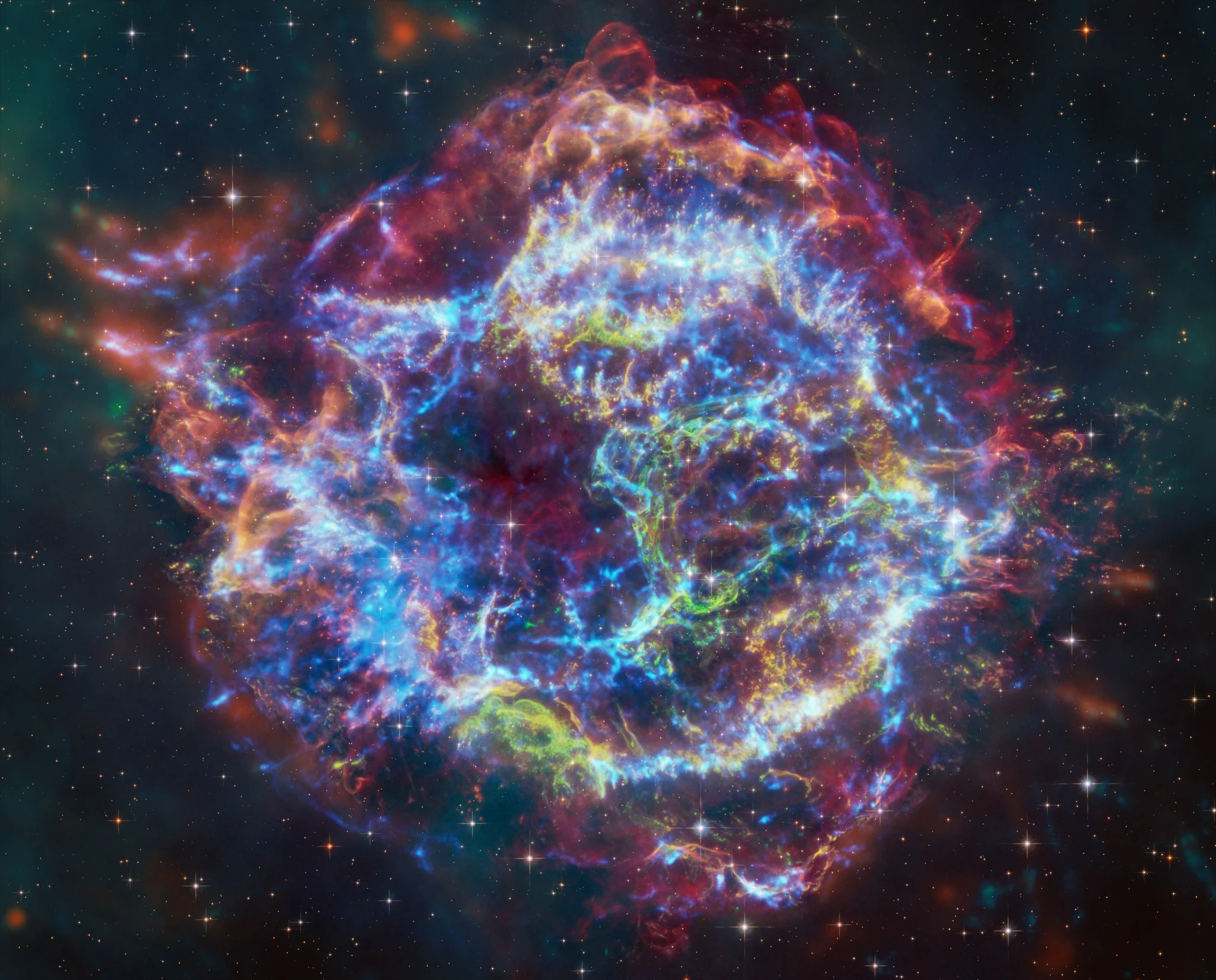
The Cassiopeia A supernova remnant is a well-studied object that emits light across multiple wavelengths, including X-ray, visible, and infrared. A composite image released on January 8, 2024, beautifully illustrates this multi-wavelength emission. The image combines X-ray data from NASA’s Chandra X-ray Observatory, infrared data from the Webb Space Telescope, and optical data from the Hubble Space Telescope. The X-ray portion is shown in blue, while the infrared data appears in red, green, and blue hues. The optical data is represented in red and white.
Details of the XRISM Discovery of Chlorine and Potassium
The detection of chlorine and potassium in Cas A by XRISM is significant because it provides new insights into the chemical composition of supernova remnants. These elements had not been observed in X-ray wavelengths from this remnant before. XRISM’s advanced imaging and spectroscopy capabilities allowed scientists to identify the unique X-ray signatures of chlorine and potassium within the debris field left by the exploded star.
This discovery enhances our understanding of the processes that occur during and after a supernova explosion. By analyzing the presence of these elements, researchers can learn more about the nucleosynthesis—the formation of new elements—that takes place in such cosmic events. The identification of chlorine and potassium adds to the growing inventory of elements detected in Cas A, helping to build a more complete picture of the supernova’s aftermath.
Multi-Wavelength Observations of Cassiopeia A
The composite image of Cassiopeia A released in early 2024 highlights the importance of observing astronomical objects across different wavelengths. The X-ray data from Chandra reveals the high-energy processes occurring in the remnant. Meanwhile, the infrared data from Webb captures cooler dust and gas, and the optical data from Hubble shows the visible light emitted by the remnant’s material.
Together, these observations provide a comprehensive view of Cas A’s structure and composition. The image processing was carried out by teams at NASA’s Chandra X-ray Center and the Space Telescope Science Institute, with contributions from researchers including J. Schmidt and K. Arcand. The infrared data also involved collaboration with NASA’s Jet Propulsion Laboratory and Caltech, as well as other institutions.
In summary, the XRISM finds chlorine potassium in the Cassiopeia A supernova remnant represent a major advancement in X-ray astronomy. This discovery not only confirms the presence of these elements in the supernova debris but also opens new avenues for studying the chemical evolution of exploded stars. The combined efforts of multiple space telescopes and observatories continue to deepen our understanding of the cosmos through detailed, multi-wavelength observations.
For more stories on this topic, visit our category page.
Source: original article.