
NASA JAXA XRISM Finds Elemental Bounty in Supernova Remnant Cassiopeia A
For the first time, scientists have clearly detected chlorine and potassium in the remains of a star using data from the Japan-led XRISM (X-ray Imaging and Spectroscopy Mission) spacecraft. The Resolve instrument aboard XRISM, pronounced “crism,” identified these elements in the supernova remnant known as Cassiopeia A, or Cas A. This expanding cloud of stellar debris lies approximately 11,000 light-years away in the northern constellation Cassiopeia.
“This discovery helps illustrate how the deaths of stars and life on Earth are fundamentally linked,” said Toshiki Sato, an astrophysicist at Meiji University in Tokyo. He explained that stars, which may seem to shimmer quietly in the night sky, actively create materials that form planets and enable life. Thanks to XRISM, scientists now have a clearer understanding of when and how stars produce crucial but harder-to-detect elements like chlorine and potassium.
A scientific paper detailing these findings was published on December 4 in Nature Astronomy. The study was led by Toshiki Sato along with Kai Matsunaga and Hiroyuki Uchida, both from Kyoto University in Japan. The XRISM mission is led by JAXA (Japan Aerospace Exploration Agency) in collaboration with NASA, with contributions from ESA (European Space Agency). NASA and JAXA jointly developed the Resolve instrument.
How NASA JAXA XRISM Finds Rare Elements in Stellar Explosions
Stars generate nearly all elements heavier than hydrogen and helium through nuclear fusion reactions. Inside stars, heat and pressure fuse lighter elements like carbon into heavier ones such as neon, forming onion-like layers of different materials. When stars exhaust their fuel, they collapse and explode in supernovae, triggering additional nuclear reactions. The elemental makeup and distribution in the resulting debris provide clues about the star’s life and its explosive death, even centuries or millennia later.
Common elements like oxygen, carbon, and neon are easier to detect and trace back to specific stages of a star’s life. However, rarer elements such as chlorine and potassium are more elusive. Due to limited data, scientists find it challenging to model where these elements formed inside stars. Despite their rarity, these elements are important for life on Earth. For example, potassium plays a vital role in the function of cells and muscles, making its cosmic origins of great interest to astronomers.
The Cas A supernova remnant is roughly circular, spanning about 10 light-years, and is over 340 years old. At its center lies a superdense neutron star, the collapsed core of the original star. Previous observations by NASA’s Chandra X-ray Observatory had identified elements like iron, silicon, and sulfur within Cas A.
In December 2023, the XRISM spacecraft’s Resolve instrument observed Cas A twice. The team detected clear signatures of chlorine and potassium, finding that their abundance ratios in the remnant were much higher than expected. Resolve also found a possible sign of phosphorus, an element previously discovered in Cas A by infrared missions.
Implications of NASA JAXA XRISM Finds on Understanding Stellar Explosions
The high resolution and sensitivity of the Resolve instrument made these measurements possible. Brian Williams, the XRISM project scientist at NASA’s Goddard Space Flight Center, emphasized that combining XRISM’s capabilities with those of other missions enables scientists to detect and measure rare elements critical to life’s formation in the universe.
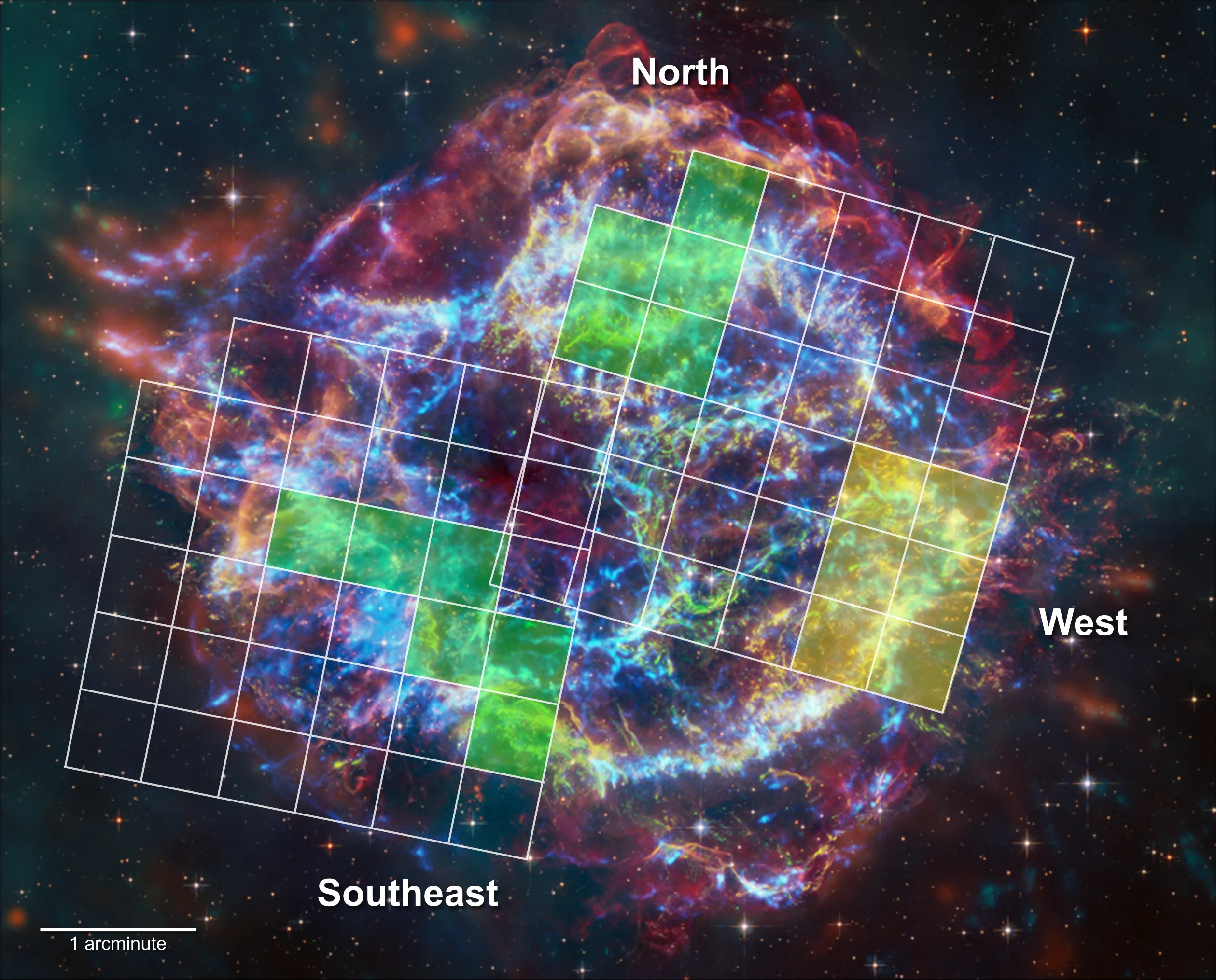
Researchers believe that turbulent activity inside the star before its explosion may have disrupted the layers of nuclear fusion. This churning could have created conditions that allowed chlorine and potassium to form in abundance. Mapping the Resolve data onto images of Cas A taken by Chandra showed that these elements were concentrated mainly in the southeast and northern parts of the remnant.
This uneven distribution suggests that the star itself had asymmetries before exploding, a conclusion supported by earlier Chandra data from a study led by Sato. Co-author Paul Plucinsky, an astrophysicist at the Center for Astrophysics | Harvard & Smithsonian, noted that measuring these rarer elements with good precision helps scientists better understand the nuclear fusion processes inside stars before and during supernovae.
While asymmetry appears to be a key factor, much remains unknown about how stars explode and distribute elements throughout the cosmos. The findings from NASA JAXA XRISM provide valuable insights but also highlight the complexity of stellar explosions and the ongoing quest to unravel their mysteries.
For more stories on this topic, visit our category page.
Source: original article.