
Hubble Spots a Storm of New Stars in Galaxy NGC 1792
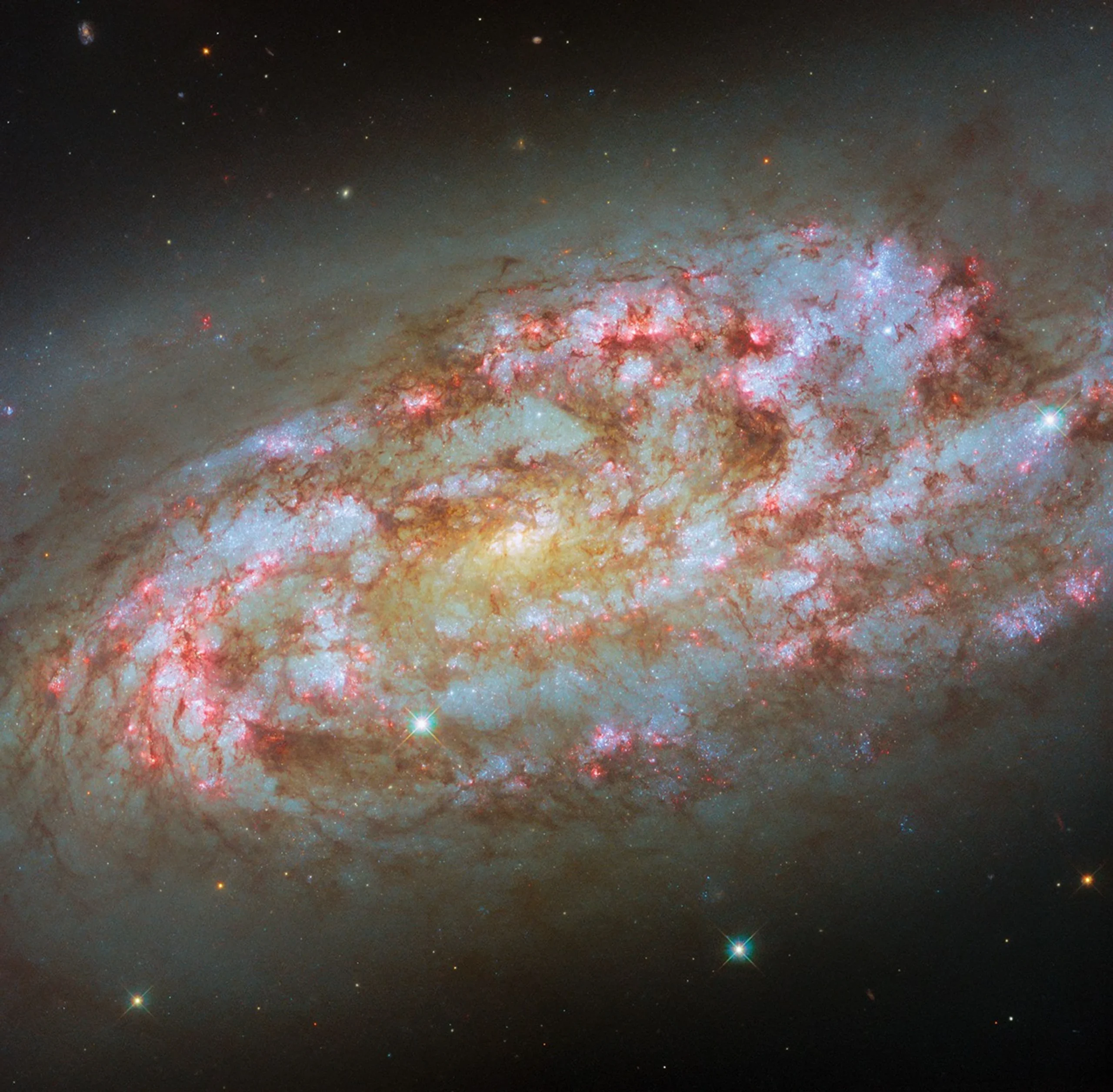
The NASA/ESA Hubble Space Telescope has captured a striking image of the spiral galaxy NGC 1792, revealing a storm of new stars forming within its swirling arms. Located more than 50 million light-years away in the constellation Columba, also known as the Dove, this galaxy displays a bright central glow offset by flocculent, sparkling spiral arms. These arms are rich with star-forming regions, making NGC 1792 a fascinating subject for astronomers studying stellar birth.
NGC 1792 is classified as a starburst galaxy, meaning it is undergoing an intense period of star formation. Despite its relatively modest mass, it shines with surprising luminosity. Astronomers believe this burst of activity is linked to the galaxy’s close proximity to a larger neighbor, NGC 1808. The gravitational forces between these two galaxies have stirred up vast reserves of gas within NGC 1792. This interaction has triggered a torrent of star formation, especially on the side of the galaxy facing its neighbor, where gravity’s influence is strongest.
Understanding the Starburst Activity in NGC 1792
The storm of new stars in NGC 1792 offers astronomers a valuable opportunity to study the complex interplay between gas clouds, star clusters, and supernovae in galaxies. The latest Hubble image includes data collected throughout 2025, providing a deeper view of the galaxy’s tumultuous activity. Bright red patches scattered along the spiral arms mark regions emitting Hydrogen-alpha (H-alpha) light, a specific red wavelength that signals the presence of dense hydrogen clouds.
Within these clouds, new stars are forming and shining with intense ultraviolet radiation. This radiation ionizes the surrounding hydrogen gas, stripping electrons from the atoms and causing the gas to emit the characteristic H-alpha light. The presence of this emission is a clear indicator of ongoing star formation. The vivid red glow seen in the arms of NGC 1792 is a direct sign of these stellar nurseries, highlighting the galaxy’s dynamic and active nature.
Hubble’s Continued Exploration of Starburst Galaxies
Hubble has observed NGC 1792 before, but the new data collected in 2025 offers a more detailed look at the processes driving star formation in this galaxy. By studying galaxies like NGC 1792, astronomers hope to better understand how gravitational interactions influence the gas within galaxies and trigger waves of star birth. This research sheds light on the life cycles of galaxies and the forces shaping the universe.
The image of NGC 1792 not only showcases the beauty of a starburst galaxy but also demonstrates the power of the Hubble Space Telescope in capturing detailed views of distant cosmic phenomena. As Hubble spots a storm of new stars in galaxies like NGC 1792, it continues to provide invaluable insights into the workings of the cosmos, helping scientists unravel the mysteries of star formation and galactic evolution.
For more stories on this topic, visit our category page.
Source: original article.