
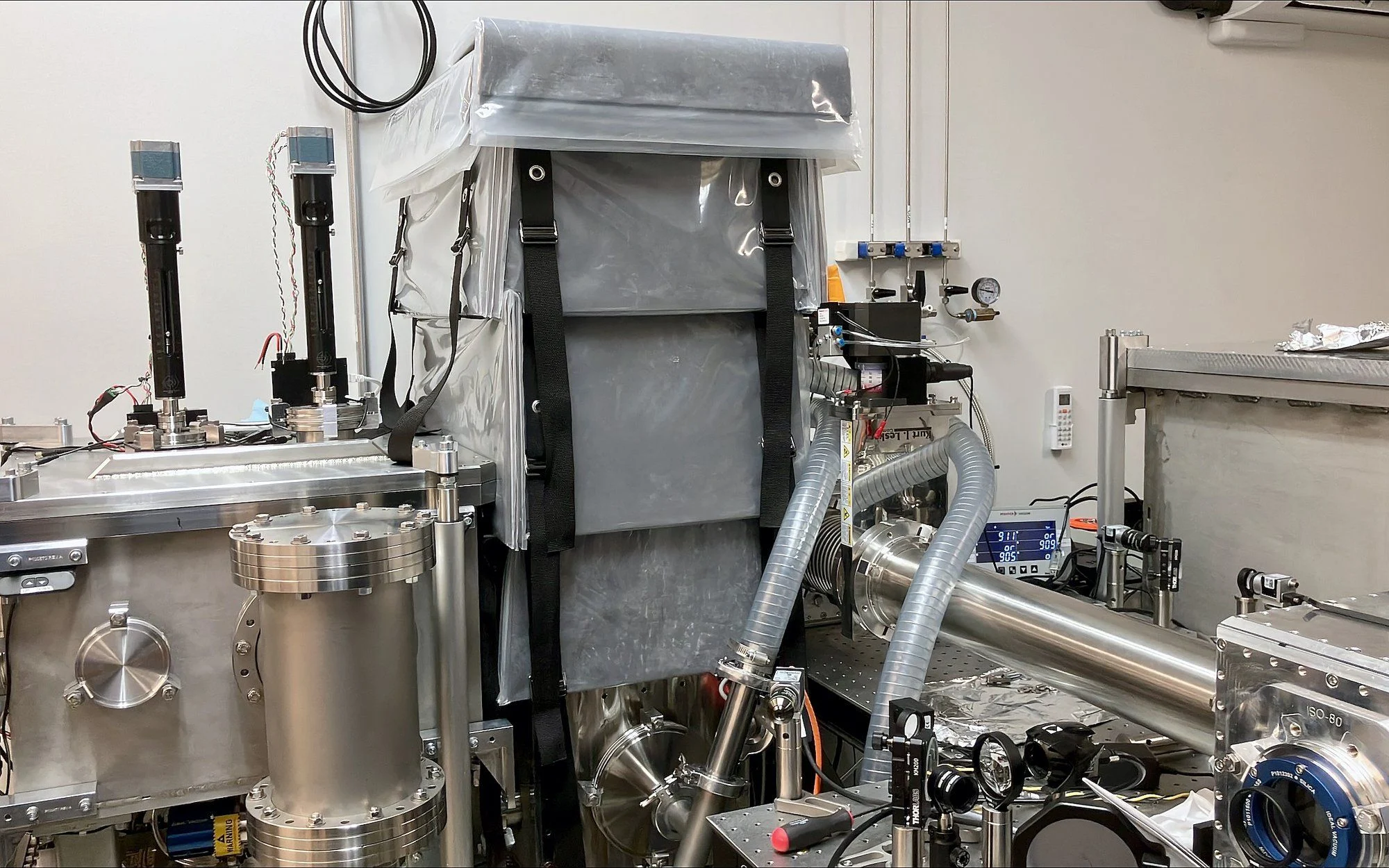
Room Size Particle Accelerators: A New Era in Compact Technology
Particle accelerators have traditionally been enormous machines, such as the 3.2-kilometer-long SLAC National Accelerator Lab in Stanford, California. However, recent advances have focused on drastically shrinking these devices by using lasers to accelerate particles instead of conventional methods. This innovation has led to the development of room size particle accelerators, which fit within a single room and cost significantly less than their large-scale counterparts. A startup called TAU Systems has now announced the first commercial laser-powered accelerator of this kind, successfully accelerating a beam of electrons. These compact accelerators are expected to find initial applications in radiation testing of electronics designed for satellites and spacecraft.
The underlying principle of this technology dates back to 1979. It involves firing an extremely powerful and ultra-short laser pulse into a gas, creating a plasma. This plasma oscillates in the wake of the laser pulse, dragging electrons along and accelerating them to relativistic speeds. Known as wakefield accelerators, these devices can generate acceleration fields up to 1,000 times stronger than those in conventional particle colliders. Scientists have long believed that wakefield accelerators could reduce the size of kilometer-scale facilities down to room size or even smaller.
TAU Systems and the Commercialization of Room Size Particle Accelerators
Björn Manuel Hegelich, founder and CEO of TAU Systems in Austin, Texas, emphasizes the goal of democratizing access to this technology. “We want to get these incredible tools into the hands of the best and brightest and let them do their magic,” he says. TAU has now successfully produced electron beams using its commercial laser-powered wakefield accelerator. While laser-powered accelerators have existed in academic labs for over 20 years, Hegelich points out that this is the first time such devices have been made available as practical tools for industry. This milestone marks a significant shift toward making compact accelerators useful beyond academia.
The accelerator developed by TAU uses a laser supplied by the Thales Group in France, noted for its exceptional stability. Hegelich explains that the focus is on reliability and reproducibility rather than pushing for record-breaking performance. The first commercial units will fit within a single room, with plans to eventually reduce the laser system to the size of a large cabinet.
TAU’s initial commercial accelerator will be installed at their facility in Carlsbad, California, which will serve as a showroom for customers to explore the technology. The company plans to offer access to the accelerator for commercial and government clients starting in 2026. This first system will operate in the range of 60 to 100 million electron volts (MeV) at 100 Hz, with the potential for future upgrades to higher energies. Hegelich notes that they are not rushing to achieve the highest energies yet, as there are many practical applications in the 100 to 1,000 MeV range where traditional accelerators are too large to be practical. For context, the SLAC linear accelerator can reach electron energies up to 50 GeV.
Applications and Future Prospects of Room Size Particle Accelerators
At the initial energy range of 60 to 100 MeV, which requires a laser system with about 200 millijoules of pulse energy, these room size particle accelerators will be particularly useful for radiation testing of electronics destined for space. Hegelich highlights a significant supply-demand gap in this area, with the technology poised to address the needs of the space industry. He believes that solving this radiation testing challenge will accelerate the growth potential of the space sector, which is becoming increasingly important to the global economy.
Looking ahead, TAU plans to increase the laser energy to about 1 joule, enabling electron beam energies between 100 and 300 MeV. This upgrade will allow testing of thicker devices and open opportunities in high-precision, high-throughput medical imaging and radiation therapy. The company aims to offer radiation therapy that competes with the best proton therapy options but at a fraction of the cost.
The 100 to 300 MeV range will also support imaging of advanced 3-D microchips, which are critical for artificial intelligence hardware. Hegelich stresses the importance of accelerating the design and manufacturing cycle to keep pace with AI’s rapid growth. Current imaging tools require hours for high-resolution failure analysis, but TAU’s next-generation sources will reduce this time to minutes or less.
Further advancements could involve multi-joule lasers generating electron beam energies from 300 to 1,000 MeV. Such powerful accelerators could drive X-ray free electron lasers, the brightest terrestrial X-ray sources ever created. These could be used in next-generation X-ray lithography to push Moore’s Law to its fundamental limits. Hegelich notes that many proposed solutions for advancing chip manufacturing rely on particle accelerators, and TAU’s compact devices make these proposals economically feasible without needing to redesign modern chip fabrication facilities.
Beyond industry, these accelerators could transform fundamental scientific research. Campus-sized accelerators and light sources have been essential tools for cutting-edge research in energy, matter, chemistry, biology, and materials science for nearly a century. However, their size and cost have limited their availability. TAU’s technology shrinks these large facilities to room size or smaller, potentially making them ubiquitous and vastly expanding scientific knowledge.
The new accelerator will have a starting price of $10 million and up, depending on the application and features. Much of the cost lies in the ultrahigh intensity laser that powers the accelerator. Hegelich points out that these lasers are still in their infancy as scientific systems, so there is substantial potential to reduce both cost and size as the technology matures. This ongoing development promises to make room size particle accelerators more accessible and practical for a wide range of uses in the near future.
For more stories on this topic, visit our category page.
Source: original article.