
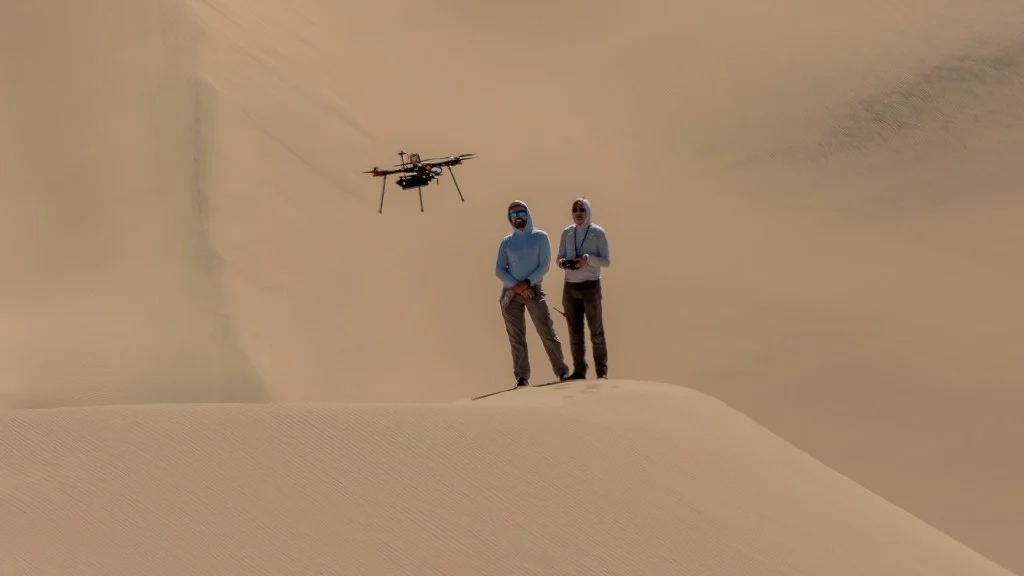
NASA Tests Drones in Desert Environments to Prepare for Mars Exploration
NASA’s Jet Propulsion Laboratory (JPL) in Southern California recently conducted a series of drone tests in California’s Death Valley National Park and the Mojave Desert. The purpose was to develop and refine navigation software for future rotorcraft missions on Mars. These barren desert dunes provide a close analogue to the featureless terrain found on the Red Planet, allowing researchers to simulate Martian conditions here on Earth.
The drone project, called Extended Robust Aerial Autonomy, is one of 25 technologies funded by NASA’s Mars Exploration Program this year. These technologies aim to advance the capabilities of robotic explorers on Mars. The need for improved navigation software became clear after NASA’s Ingenuity Mars Helicopter struggled with the dunes on Mars during its later flights, including its 72nd and final flight. The dunes confused Ingenuity’s navigation algorithms, which rely on visual features on the ground to estimate motion.
Challenges of Navigating Mars-Like Terrain
Roland Brockers, a JPL researcher and drone pilot, explained that Ingenuity was designed to fly over terrain with distinct visual features. However, when it encountered bland, featureless areas like sand dunes, it became difficult for the helicopter to navigate. The goal of the new drone software is to enable future vehicles to fly confidently over challenging terrain without being hindered by a lack of visual cues.
The Mars Exploration Program is also developing other advanced technologies, such as slope-scaling robotic scouts and long-distance gliders. These innovations envision a future where robots can explore Mars autonomously or assist astronauts in their missions.
Desert Testing Grounds for Mars Technologies
NASA has a long history of using Death Valley as a testing ground for Mars exploration technologies. Since the 1970s, when the agency prepared for the Viking landers, scientists have studied the area’s volcanic boulders and barren slopes, known as Mars Hill. More recently, JPL engineers tested the Perseverance rover’s precision landing system by flying a component of it in a piloted helicopter over Death Valley.
In 2025, JPL’s drone team conducted tests at Mars Hill and the Mesquite Flats Sand Dunes in Death Valley. They were granted only the third-ever license to fly research drones in the park. Despite temperatures reaching up to 113 degrees Fahrenheit (45 degrees Celsius), the team monitored their drones’ progress under a pop-up canopy, tracking data on laptops.
These tests have yielded valuable insights. For example, researchers discovered how different camera filters improve the drones’ ability to track the ground. They also developed new algorithms that help drones land safely in cluttered terrain similar to Mars Hill’s rocky environment.
Mike Reynolds, Superintendent of Death Valley National Park, expressed enthusiasm about the research. He emphasized that the park serves not only as a place of natural beauty and recreation but also as a living laboratory that supports space exploration and helps us understand desert environments on Earth and beyond.
The team also conducted additional testing at Dumont Dunes in the Mojave Desert. This site, previously used for mobility tests on NASA’s Curiosity rover in 2012, features rippled dunes that provide a different type of featureless terrain for evaluating flight software.
Nathan Williams, a JPL geologist and former Ingenuity operator, highlighted the importance of field tests. He noted that real-world testing offers a more comprehensive understanding than computer models or satellite images alone. Since scientifically interesting features on Mars may be located in difficult terrain, preparing for such challenges is essential.
Robotic Scouts and Mars Flyers
In addition to drone tests in California, NASA researchers from the Johnson Space Center tested a robot called LASSIE-M (Legged Autonomous Surface Science In Analogue Environments for Mars) in New Mexico’s White Sands National Park. This doglike robot uses motors in its legs to measure surface properties. It can adjust its gait when encountering soft, loose, or crusty terrain, which often signals scientifically valuable changes. The goal is to develop a robot capable of scaling rocky or sandy terrain to scout ahead of humans and other robots, using instruments to identify new scientific targets.
Another Mars Exploration Program project focuses on an autonomous flying robot called the Mars Electric Reusable Flyer (MERF), developed by NASA’s Langley Research Center in Virginia. Unlike Ingenuity, which is compact, MERF is designed with wings to achieve greater range. It features a single wing with twin propellers that allow vertical takeoff and hovering. Without a fuselage or tail, the design remains lightweight enough to operate in Mars’ thin atmosphere.
Langley engineers have tested a half-scale model of MERF on their Virginia campus, studying its aerodynamics and lightweight materials. At full size, MERF would be about as long as a small school bus. Equipped with instruments on its underside, it could map the Martian surface while flying at high speeds.
Alongside these projects, NASA is also advancing new power generation methods, drilling and sampling equipment, and autonomous software. Together, these technologies will expand the ways NASA explores Mars in the future, enabling more versatile and capable robotic missions.
By testing drones in Earth’s harsh desert environments, NASA is preparing for the challenges of flying and navigating on Mars. These efforts bring the agency closer to deploying advanced robotic explorers that can operate independently and support human missions on the Red Planet.
For more stories on this topic, visit our category page.
Source: original article.