
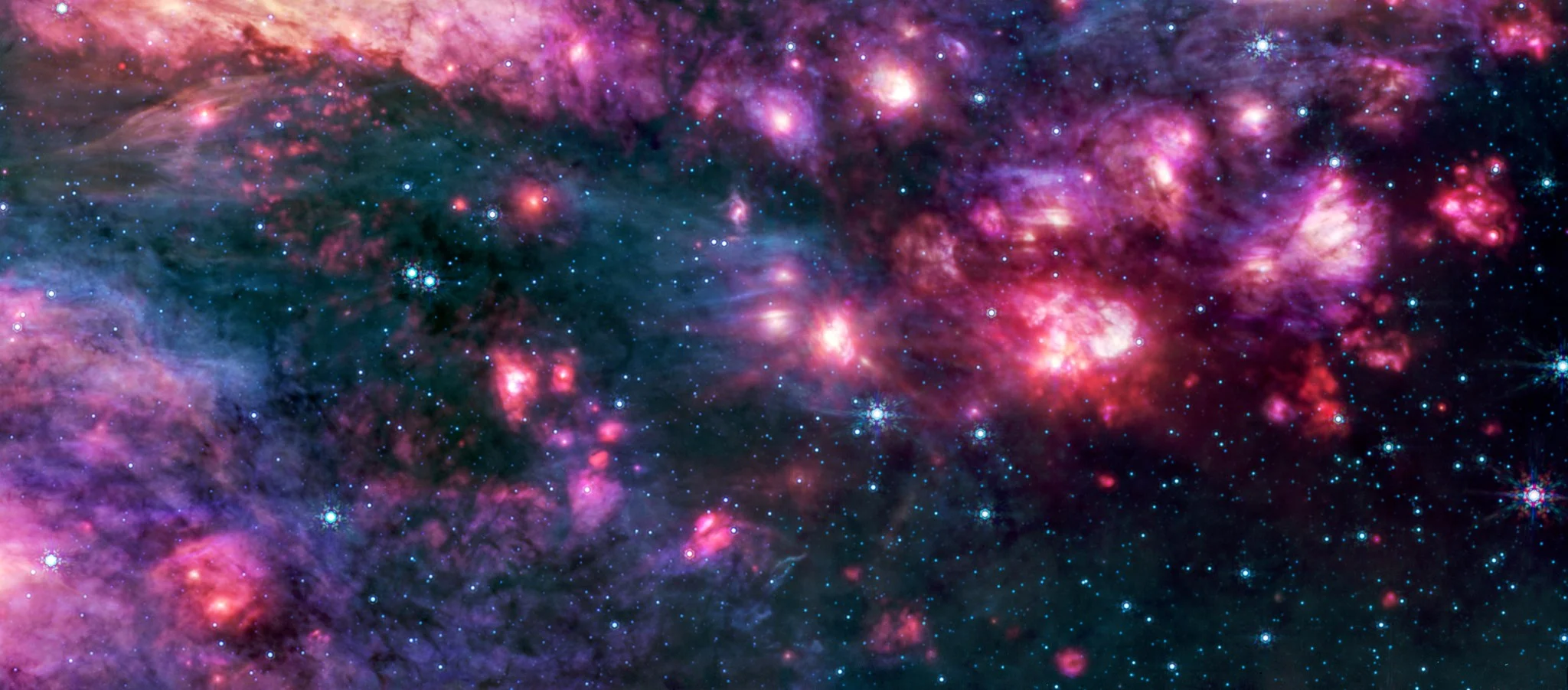
Unveiling the Sagittarius B2 Molecular Cloud with the James Webb Space Telescope
The Sagittarius B2 molecular cloud, known as Sgr B2, has been captured in extraordinary detail by NASA’s James Webb Space Telescope. Using its Mid-Infrared Instrument (MIRI), the telescope revealed glowing cosmic dust heated by very young, massive stars within this region. This remarkable image, released on September 24, 2025, offers an unprecedented view of one of the most active star-forming areas in our galaxy.
Sgr B2 is the largest and most active star-forming region near the center of the Milky Way. It lies just a few hundred light-years away from the galaxy’s central supermassive black hole. Despite containing only about 10% of the gas found in the galactic center, this molecular cloud is responsible for producing half of the stars in that region. This striking imbalance has intrigued astronomers, who are eager to understand why Sgr B2 is so much more active than the surrounding galactic center.
The Role of the Mid-Infrared Instrument in Studying Sagittarius B2 Molecular Cloud
The Mid-Infrared Instrument on the James Webb Space Telescope plays a crucial role in studying the Sagittarius B2 molecular cloud. MIRI combines a camera and a spectrograph that detect light in the mid-infrared range of the electromagnetic spectrum. This capability allows scientists to observe the colorful stars embedded within the cloud, as well as the bright clouds of gas and dust that surround them.
The detailed images from MIRI highlight the intricate structures within Sgr B2, showing stars punctuated by glowing gas and dust clouds. By analyzing the light captured, astronomers can gather important information about the masses and ages of these stars. This data is essential for improving our understanding of how stars form in such dense and active environments near the galactic center.
Why Sagittarius B2 Molecular Cloud Is a Key to Understanding Star Formation
The Sagittarius B2 molecular cloud stands out as a unique laboratory for studying star formation in extreme conditions. Its proximity to the Milky Way’s central black hole and its intense star-forming activity make it an ideal target for astronomers. The fact that Sgr B2 produces half of the stars in the galactic center despite having only a fraction of the gas raises important questions about the processes driving star formation there.
By closely examining the stars and the glowing dust within Sgr B2, researchers hope to uncover the factors that lead to its remarkable productivity. The insights gained from studying this molecular cloud will not only shed light on star formation in our own galaxy but may also help explain similar processes in other galaxies with active centers.
The image of the Sagittarius B2 molecular cloud was created through the combined efforts of NASA, ESA, CSA, and the Space Telescope Science Institute. Contributions from scientists Adam Ginsburg, Nazar Budaiev, and Taehwa Yoo of the University of Florida, along with image processing by Alyssa Pagan at STScI, have brought this stunning view to the scientific community and the public.
In summary, the James Webb Space Telescope’s observations of the Sagittarius B2 molecular cloud provide a detailed glimpse into one of the most dynamic star-forming regions in the Milky Way. Through the power of mid-infrared imaging, astronomers are gaining valuable knowledge about the birth and evolution of stars in this extraordinary cosmic environment.
For more stories on this topic, visit our category page.
Source: original article.