
Rings of Rock in the Sahara: Geological Wonders in Northeastern Africa
In the driest region of the Sahara Desert, located in northeastern Africa, dark rocky outcrops rise prominently above the pale desert sands. Among these remarkable formations is Jabal Arkanū, which features striking ring-shaped structures that capture the attention of scientists and explorers alike. These rings of rock in the Sahara stand out as fascinating geological features in an otherwise vast and barren landscape.
Jabal Arkanū, also spelled Arkenu, is situated in southeastern Libya near the border with Egypt. It is part of a cluster of massifs that includes Jabal Al Awaynat (or Uweinat), located about 20 kilometers (12 miles) to the southeast. Approximately 90 kilometers to the west lie similarly named Arkenu structures. Initially, these circular formations were believed to be the result of meteorite impacts. However, subsequent field studies revealed that they formed through terrestrial geological processes rather than extraterrestrial collisions.
Formation and Composition of the Rings of Rock in the Sahara
The ring-shaped structures of Jabal Arkanū are now understood to have an earthly origin. Scientists believe they formed as magma pushed upward toward the surface, intruding into the surrounding rock layers. This process occurred repeatedly, creating a series of overlapping rings. The centers of these rings are roughly aligned toward the southwest, forming a complex geological pattern.
This ring complex consists primarily of igneous rocks, including basalt and granite. To the north, the complex is bordered by a distinctive hat-shaped formation made up of sandstone, limestone, and quartz layers. These diverse rock types highlight the complex geological history of the region and the dynamic processes that shaped it.
Visual and Environmental Features of Jabal Arkanū
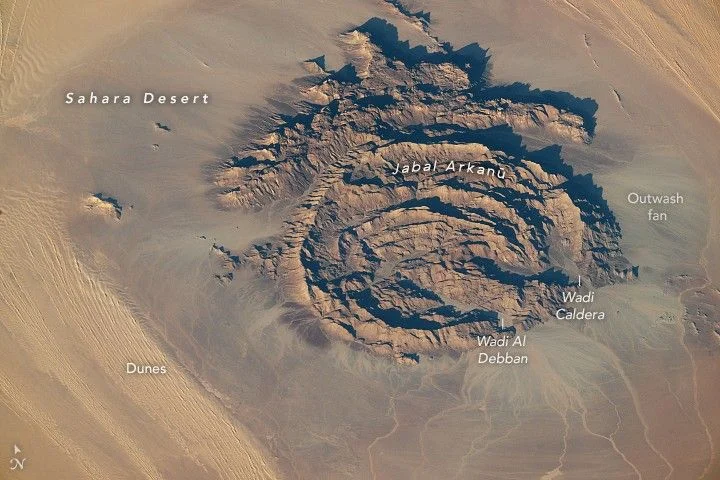
A photograph taken from the International Space Station on September 13, 2025, reveals the massif casting long shadows over the desert landscape. The ridges of Jabal Arkanū rise to nearly 1,400 meters above sea level, which is about 800 meters higher than the surrounding sandy plains. At the base of the mountain, several outwash fans composed of boulders, gravel, and sand spread outward toward adjacent longitudinal dunes.
Two wadis, which are typically dry riverbeds, wind through the rocky structure. Despite their presence, water is extremely scarce in this part of the Sahara. Research using data from NASA and JAXA’s Tropical Rainfall Measuring Mission (TRMM) has shown that southeastern Libya, along with neighboring areas of Egypt and northern Sudan, receives only about 1 to 5 millimeters of rainfall annually. Slightly higher rainfall amounts, ranging from 5 to 10 millimeters per year, occur near Jabal Arkanū and nearby massifs. This suggests a modest orographic effect, where the mountains cause a small increase in precipitation.
The image of Jabal Arkanū was captured by an astronaut aboard the International Space Station using a Nikon Z9 digital camera with an 800-millimeter focal length. The photograph was taken by a member of Expedition 73 and was enhanced to improve contrast and remove lens artifacts. This image is part of the ISS Crew Earth Observations program, which supports astronauts in capturing valuable Earth images for scientific and public use. These images are freely available online through NASA’s Gateway to Astronaut Photography of Earth.
In summary, the rings of rock in the Sahara, exemplified by Jabal Arkanū, offer a unique glimpse into the geological processes that have shaped this arid region. Their formation through magma intrusion, the complex layering of rock types, and the stark desert environment all contribute to the fascinating natural history of northeastern Africa’s driest landscapes.
For more stories on this topic, visit our category page.
Source: original article.