
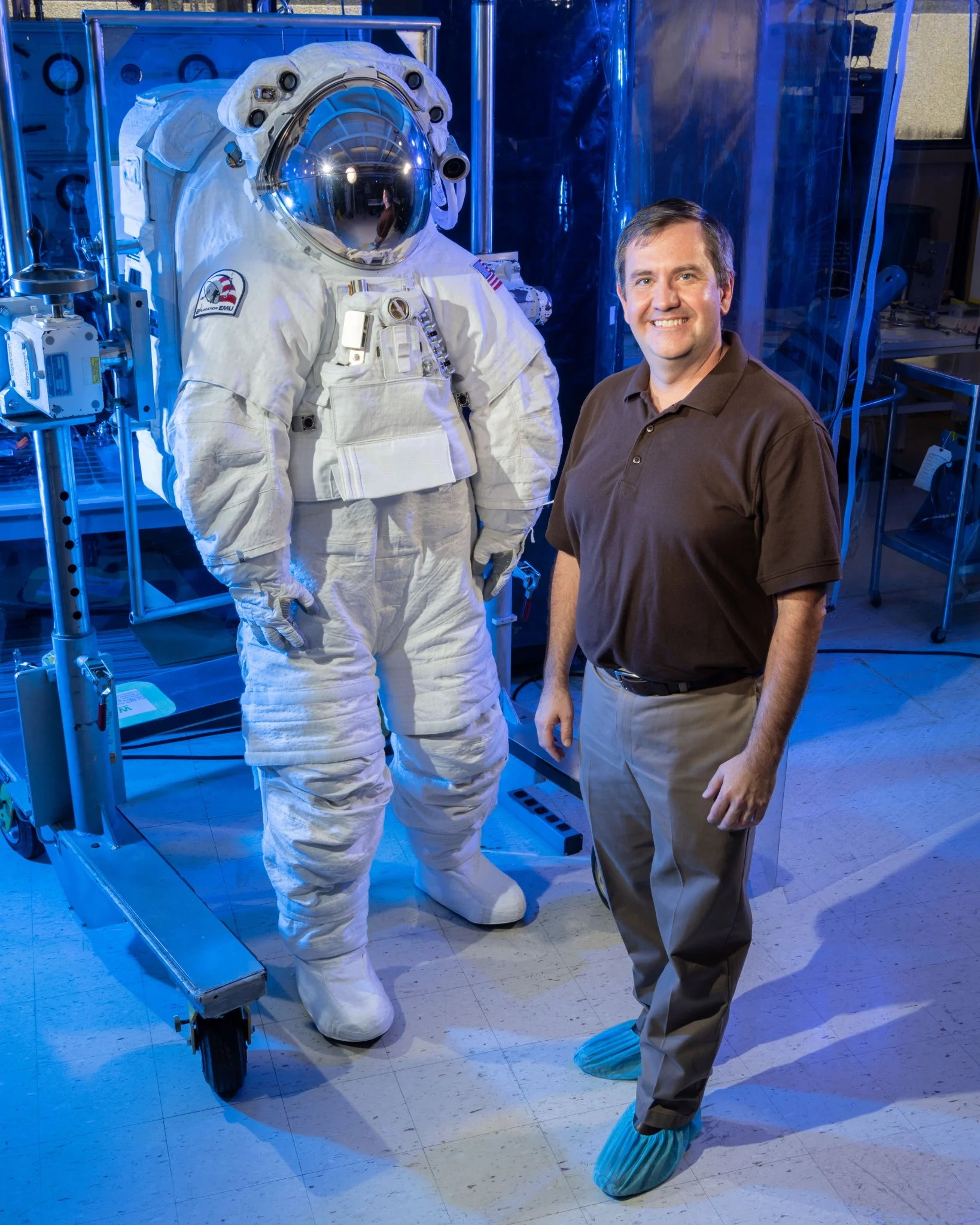
Mark Elder Building the Future of Spacewalking for Artemis and Beyond
For more than 25 years, Mark Elder has played a vital role in making human spaceflight both safe and achievable. As the International Space Station Extravehicular Activity (EVA) hardware manager within NASA’s EVA and Human Surface Mobility Program, he leads the team responsible for the spacesuits, tools, and logistics that protect astronauts during spacewalks. His work ensures NASA is fully prepared for the upcoming era of Artemis exploration.
Elder’s team holds programmatic responsibility for the Extravehicular Mobility Unit (EMU) spacesuit. This means every component astronauts depend on outside the International Space Station, from bolts to bearings to batteries, falls under their careful supervision. Additionally, he manages the EVA Space Operations Contract, which provides essential engineering and technical support to keep spacesuit systems ready for flight.
Mark Elder Building the Expertise Behind Every Spacewalk
Elder’s work directly supports every EVA conducted at the space station. His team collaborates closely with astronauts, engineers, and the Mission Control Center in Houston to ensure that suits and tools function reliably in one of the harshest environments imaginable. Their efforts are crucial for conducting spacewalks safely and successfully.
His passion for NASA began early in life. “When I was little, my parents gave me a book called ‘The Astronauts,’” Elder recalled. “It had drawings of a reusable spacecraft—the space shuttle—and I fell in love with it. From then on, I told everyone I was going to work at NASA.” This dream took root further at age 16 when he attended Space Academy in Huntsville, Alabama. “That cemented my dream of someday working at NASA, and it taught me a little bit more about the different roles within the agency,” he said.
While studying mechanical engineering at Case Western Reserve University, Elder learned about a NASA program that allowed college students to design and build experiments to fly aboard the Boeing KC-135 Stratotanker. “I jumped on the chance to be part of the team,” he said. This experience deepened his desire to work at NASA, particularly at Johnson Space Center.
After graduation, Elder initially worked at Pratt & Whitney on jet engines. Although valuable, he knew his true passion was human spaceflight. Discovering that Hamilton Sundstrand, a fellow United Technologies company, was the prime contractor for spacesuits, he transferred there and began his NASA career.
Mark Elder Building the Future of Spacewalking Technology and Leadership
Elder’s first three years at Johnson involved performing tool-to-tool fit checks on spacewalking equipment. This hands-on experience gave him familiarity with nearly every tool he would later manage as a hardware manager. His early career coincided with the shuttle return-to-flight era, where he worked on reinforced carbon-carbon panel repairs and thermal protection systems. These technical challenges laid the foundation for his future leadership roles.
As his career progressed, Elder took on more complex projects, including leading the team that developed the EVA Long Life Battery. This was the first human-rated lithium battery used in space. His team created a rigorous test plan to certify the battery for human spaceflight during a time when lithium batteries faced safety scrutiny. “Finally signing the certification paperwork was satisfying, but watching an EVA powered by the batteries provided a great sense of pride,” he said. This innovation paved the way for safer, higher-capacity batteries that power current spacewalks and will support future lunar surface activities.
Elder reflects on his leadership journey with valuable lessons. “The great thing about NASA is the highly motivated and dedicated workforce,” he said. Initially, he thought leadership meant making quick decisions and moving fast. Over time, he learned that true leadership is about listening. Strong teams are built on trust and open communication.
Another important lesson for Elder has been assuming positive intent. “In a place like NASA, everyone is deeply passionate about what they do,” he explained. “It’s easy to misinterpret a disagreement as opposition, but when you remember that everyone is working toward the same goal, the conversation changes. You focus on solving problems, not winning arguments.” This mindset has helped him navigate some of NASA’s most complex programs and build lasting partnerships across the agency.
Today, Elder’s work extends beyond the orbiting laboratory. As NASA prepares for Artemis missions to the Moon, his team’s experience maintaining and improving the EMU informs the design of next-generation exploration suits. “The foundation we’ve built on the space station is critical for the future,” he said. “Every tool we’ve refined, every system we’ve upgraded—it all feeds into how we’ll operate on the lunar surface and eventually on Mars.”
Elder believes perseverance is key to future success. He encourages the next generation to never stop dreaming. “My path wasn’t direct, and it would have been easy for me to give up,” he said. “But dreams have a way of guiding you if you don’t let go of them.”
When not supporting NASA missions, Elder channels his creativity into woodworking. “In my spare time, I love woodworking,” he said. “Building something useful from a pile of rough-sawn boards helps calm me and gives me a great sense of accomplishment. I love being able to build furniture for my family,” he added, having recently finished a desk for his youngest son.
The patience and precision Elder applies to woodworking also define his approach to space exploration—steady progress, careful craftsmanship, and attention to detail. “As NASA goes to the Moon and Mars, there will be challenges,” he said. “As long as we keep dreaming, we will see the next generation walking on the Moon and heading to Mars.”
For more stories on this topic, visit our category page.
Source: original article.