
How Thin Is the Galaxy Z TriFold? Understanding Its Unique Thickness
In recent years, the mobile industry largely stopped focusing on making phones thinner, except for some markets like China. For a while, smartphones seemed to have found a good balance between thinness and battery capacity. However, in 2025, Samsung shifted the trend again by introducing the ultra-thin Galaxy Z TriFold. This new device stands out with its innovative design and impressive slimness, raising the question: how thin is the Galaxy Z TriFold?
Samsung’s Galaxy Z TriFold is the company’s first phone with two hinges, allowing it to fold twice. When folded, it has a thickness of 12.9mm. At first glance, this might not seem very thin, especially compared to the Galaxy Z Fold 7, which measures 8.9mm when folded. But the TriFold’s dual folding mechanism makes this measurement more impressive. When fully unfolded, the phone is incredibly slim, measuring only 3.9mm at its thinnest point.
Three Different Thicknesses: How Thin Is the Galaxy Z TriFold?
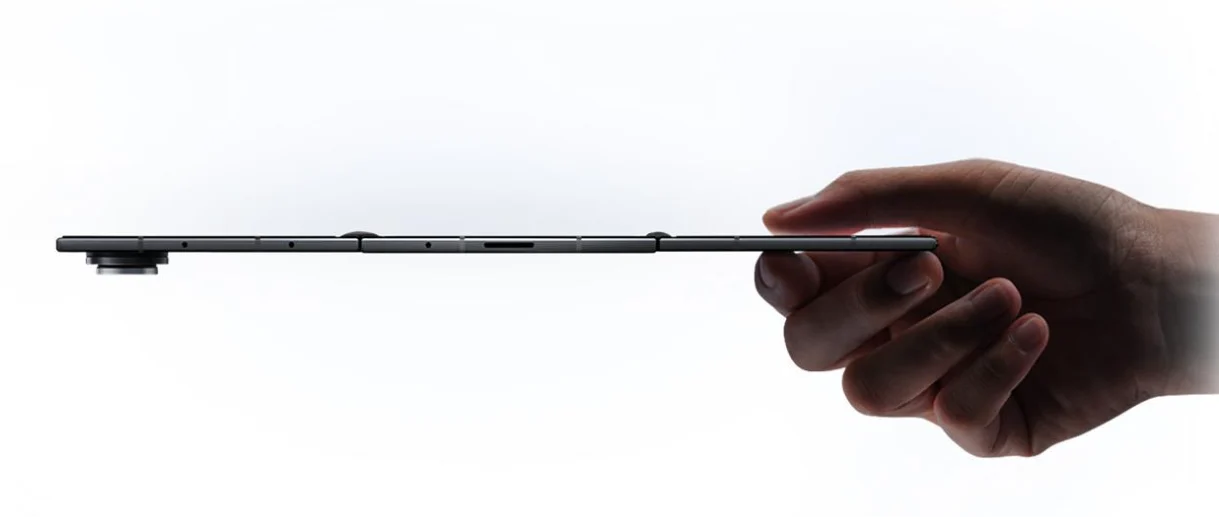
Measuring the Galaxy Z TriFold’s thickness is not straightforward because each side of the phone has a different thickness. This unique design means there isn’t a single, simple answer to how thin the phone is. Instead, there are at least three correct measurements, depending on which part of the device you look at.
The left-most side of the phone, when it is open, is the thinnest. This side measures 3.9mm. The center section, which includes the cover screen, is slightly thicker at 4.2mm. Finally, the right-most side, which houses the side buttons and camera, measures 4.0mm, not including the camera housing itself.
All these measurements exclude the thickness of the pre-installed protective film on the phone. These numbers show that the Galaxy Z TriFold is not uniformly thin across its entire body. Instead, it is thickest in the middle and tapers off slightly on both sides.
Interestingly, if you add these three thicknesses—3.9mm, 4.2mm, and 4.0mm—you get 12.1mm, which is less than the 12.9mm thickness Samsung states for the folded phone. This difference is explained by a “minimal gap” between the three panels when folded. Samsung notes that the phone does not close completely flat, leaving a small space between the panels. However, this gap is very slight and unlikely to be noticeable in everyday use.
The Camera Housing: Thicker Than the Phone Itself
Another unusual aspect of the Galaxy Z TriFold is its camera housing. The camera bump is actually thicker than the phone’s body. Samsung has not provided an official measurement for the phone’s thickness including the camera housing, so the exact figure is unknown. However, images clearly show that the camera housing protrudes beyond the phone’s slim profile.
This design feature is rare for Samsung phones. Aside from experimental devices like the Galaxy S4 Zoom from 2013, the Galaxy Z TriFold is the first Samsung phone where the camera housing is thicker than the phone itself when unfolded.
While the phone boasts a 200MP main camera, its zoom capabilities are not extraordinary. Still, the thinness of the phone around the camera housing is remarkable. The Galaxy Z TriFold demonstrates that modern phones can now be thinner than their camera modules alone. However, since this device is highly unconventional, this design choice is unlikely to become a widespread trend.
In summary, how thin is the Galaxy Z TriFold? The answer depends on which part of the phone you measure. Its thickness varies from 3.9mm to 4.2mm across different sections, with a folded thickness of 12.9mm due to the dual hinges and minimal gaps. Its camera housing stands out as a unique feature, being thicker than the phone’s body itself. This innovative design marks a new chapter in smartphone thinness and folding technology.
For more stories on this topic, visit our category page.
Source: original article.